Today I learnt that the sinologist Victor H. Mair died on 28 June 2026.
I first encountered him through T’ang Transformation Texts: A Study of the Buddhist Contribution to the Rise of Vernacular Fiction and Drama in China; later, in The True History of Tea. One of the book’s passages follows the two principal names by which tea travelled through the world. Cha moved largely along continental routes, while forms derived from the southern Chinese pronunciation Te travelled through maritime trade. Geography became pronunciation, the same leaf entered different languages according to the road, or sea route, it took.
Later I read Mair’s work on the popular narratives discovered at Dunhuang, particularly the 變文 (bianwen), or pien-wen in the older Wade–Giles romanisation. Scholars had variously explained the term as an “alternating text”, because these narratives moved between prose and verse; as the popularisation of Buddhist scripture; or as a narrative of strange events. Mair finds these explanations inadequate. The alternation between spoken prose and sung verse was characteristic of the form, but it did not explain why it was called 變. Nor did bianwen simply mean that a canonical sutra had been changed into a popular or colloquial text. Mair notes that modern Japanese 変な事 (hen na koto) means an unusual or strange occurrence, while 變 in some Six Dynasties texts approaches 奇 (qi), the strange or marvellous, and 異 (yi), the uncommon or anomalous. Yet he argues that its meaning in bianwen was more specifically Buddhist. The 變 of 變文, he writes, is related to a “Buddhist technical term meaning ‘transformation’”: the “coming or bringing into being” of a scene or deity within an “illusory reality”, corresponding to the Sanskrit ideas of māyā and nirmāṇa (Mair, Tun-huang Popular Narratives, pp. 2–3).
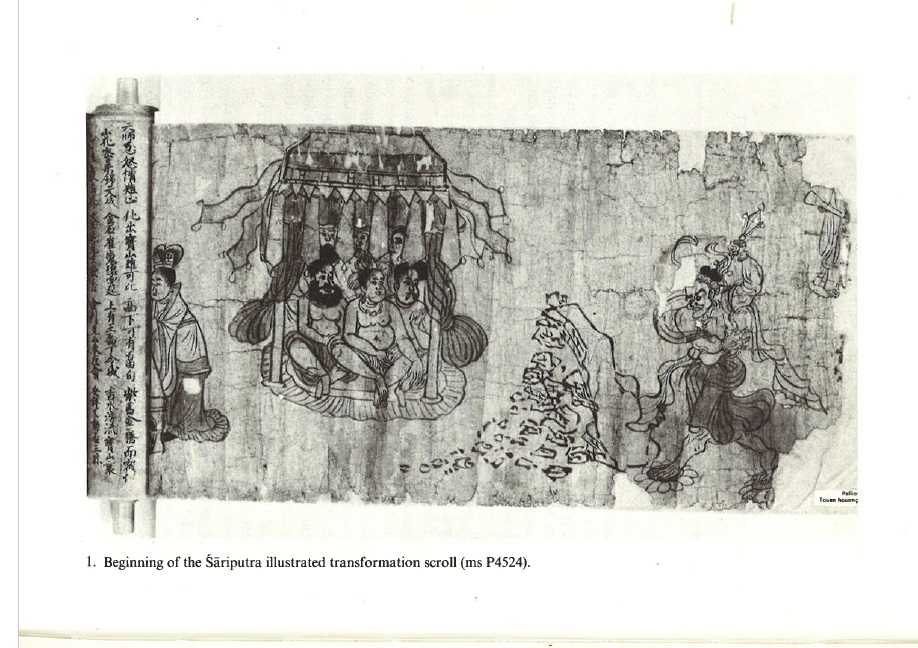
Transformation was therefore fundamentally an act of manifestation. A Buddha, bodhisattva or saint could cause an otherwise invisible being or religious realm to appear. Buddhist storytellers and performers recreated this power by combining speech, sung verse, gesture, music and visual aids. Audiences did not merely hear a doctrine explained; they heard and saw scenes of karma, death, rebirth and liberation temporarily brought before them. The related 變相 (bianxiang), which Mair translates as “transformation tableau”, gave pictorial form to the same operation performed linguistically by the 變文. Text and image were not separate illustrations of an already completed story: together they produced its appearance.
Although Buddhist in origin, this conception of transformation entered Chinese popular culture, where, Mair observes, it inspired “enormous delight”. Performers used painted scrolls, dance, descriptive language and shadow projection to make absent characters and worlds appear. The Chinese expressions 變魔術 (bian moshu), to perform magic, and 變戲法 (bian xifa), to perform a conjuring trick, preserve something of this theatrical sense of 變. Mair places the transformations of Sun Wukong within this history: Monkey’s seventy-two transformations are not merely changes occurring naturally within the cosmos, but deliberate manifestations in which one body, identity or image is made to appear as another.
Before Buddhism, China had already possessed a profound language of change in 易 (yi), as in the Yijing. 生生之謂易 “continuous generation is called yi” understands existence as ceaseless generation through shifting relations. Within this movement, 變 (bian) could already signify an alteration or turning point: 窮則變,變則通 (Qiong ze bian, bian ze tong) “when something reaches its limit, it changes; through change, it finds passage.” Buddhism did not introduce 變 into China. What it introduced was a particular religious and visual conception of transformation: the power to make another body, being or world appear.
On my first reading, I misunderstood the distinction as one between a pre-Buddhist 易 (yi) and a Buddhist 變 (bian), between change as the underlying movement of the world and change made visible as an event. But 變 was already present in pre-Buddhist Chinese thought. Mair’s argument is more specific: Buddhist 變 names a produced manifestation through which an otherwise invisible being, scene or world becomes perceptible. Mair’s account also recalls, without being equivalent to, Heidegger’s discussion of ἀπόφανσις (apophansis) and ἀποφαίνεσθαι (apophainesthai): the primordial function of logos is to let something be seen from itself. The comparison is structural rather than historical. Buddhist 變 produces or performs the appearance of an otherwise unseen being, scene or world; Heideggerian discourse does not create its object, but allows what is spoken about to show itself. Both nevertheless disturb the assumption that language merely describes an already visible reality. The bianwen performs such a manifestation through words, voices and images, while Journey to the West inherits its delight in bodies and identities assuming other forms.
Nothing travels without changing, and we too must change in order to travel; but here transformation is also the means by which something distant or unseen is made present.